
You are sitting on the couch, minding your own business, and a tiny fly drifts past your face. You swat it away and forget about it. Then another one appears. Then three more. Within a week, there are clouds of these tiny insects hovering around your plants, landing on your food, and generally making life miserable.
If this sounds familiar, you are dealing with fungus gnats. They are one of the most common houseplant pests, and they can be genuinely difficult to eliminate if you do not understand how they live and reproduce.
The good news is that fungus gnats are beatable. You just need the right approach and a little patience. Killing adult gnats alone will not solve the problem. This article explains what fungus gnats are, why they appear, the damage they cause, and how to get rid of them using methods that actually work.
What Are Fungus Gnats?
Fungus gnats are small, dark flies that belong to the scientific genus Bradysia, part of the family Sciaridae. According to Colorado State University Extension, adult fungus gnats are about one-eighth of an inch long and look somewhat like tiny mosquitoes, slender, dark-colored, with long legs and long antennae. Unlike mosquitoes, they do not bite.
One way to identify them is by their wings. The University of Georgia CAES Field Report notes that fungus gnats have a distinct Y-shaped vein pattern on their wings that is visible under a magnifying glass. If you see that, you are looking at a fungus gnat and not a fruit fly or another small insect.
Many people confuse fungus gnats with fruit flies. The easiest way to tell them apart is by where they gather. Fruit flies are attracted to ripe or rotting fruit and sugary liquids. Fungus gnats hover around the soil and fly up when you water or disturb the plant. They also tend to crawl across the soil surface in a characteristic way that fruit flies do not do.

The Lifecycle of a Fungus Gnat
Understanding the lifecycle is the single most important thing you can do to beat a fungus gnat infestation. Most people only kill the adult flies they can see. However, adults are just one stage of a four-stage lifecycle. If the other stages are not treated, the infestation will continue. Help your plants thrive by understanding how pot size affects watering, root health, and growth.
According to GrowLiv Biologicals, the fungus gnat lifecycle goes through four stages: egg, larva, pupa, and adult.
- A female fungus gnat lives for about one week. During that time, she lays between 100 and 300 eggs in the top layer of moist soil. According to the Edmonton Horticultural Society, some female fungus gnats can lay up to 1,000 eggs in their lifetime. The eggs are tiny, oval, and white, almost invisible to the naked eye, and they hatch within three to five days.
- Once hatched, the larvae are translucent white or cream-colored. They have a shiny black head and grow to about a quarter of an inch long. According to Colorado State University Extension, they live in the top two to three inches of soil. There, they feed on fungi, algae, decaying plant matter, and, in heavy infestations, plant roots. The larval stage lasts about two weeks.
- After that, the larvae pupate in the soil for approximately three to seven days before emerging as winged adult gnats. The adults live for about a week, fly around, mate, and lay eggs, starting the whole cycle again.
- STUMP Plants points out that the complete lifecycle from egg to adult takes about four weeks. The important implication of this is that any treatment plan needs to run for at least four to six weeks to catch every generation before it has a chance to reproduce again.
Why Do Gnats Appear in Houseplants?
The single most common cause of a fungus gnat infestation is moist soil. Garden Betty explains it clearly: the absolute number one cause of fungus gnats in houseplants is overwatering, or lack of drainage, which amounts to the same thing. Moist soil is attractive to adult females for two reasons.
First, damp soil is the perfect environment for eggs to survive and hatch without drying out. Second, moist soil supports the growth of fungi, algae, and decaying organic matter that larvae need to feed on. A consistently wet pot is essentially an all-you-can-eat buffet for fungus gnat larvae.
According to Scotts Miracle-Gro, gnats prefer to lay their eggs in damp soil filled with decaying organic matter, which is why they are especially common around houseplants, particularly those grown in rich potting mixes containing compost or bark.
Another common cause is new potting soil. Here She Grows notes that potting soil manufacturers do not sterilize their mixes before shipping because sterilizing would kill beneficial organisms. During shipping and time on retail shelves, bags of potting mix can be infiltrated by adult gnats looking for somewhere to lay eggs.
The small holes in the packaging are enough for a gnat to get through. This is why infestations sometimes appear after repotting a plant in fresh soil that seemed perfectly clean. New plants brought home from nurseries can also carry eggs or larvae in their soil without any visible signs.
What Damage Do Fungus Gnats Actually Cause?
Adult fungus gnats are largely harmless to plants and people. They do not bite, they do not feed on plants, and their presence alone will not kill a healthy houseplant. The damage comes from the larvae. According to UC IPM (University of California Integrated Pest Management), when larvae are present in large numbers, they can damage roots and stunt plant growth, particularly in seedlings and young plants.
The same source notes that significant root damage and even plant death have been observed in houseplants when high larval populations are combined with moist, organically-rich soil. Oklahoma State University Extension adds that larvae feed on any organic matter, as well as attacking bulbs, roots, and other fleshy organs. Delicate seedlings of many plant species can be killed, with plants yellowing and often wilting rapidly before death.
The Kansas State University Research and Extension paper on fungus gnat management notes that both adults and larvae may also spread plant pathogens as they move through the soil, meaning a gnat infestation can create secondary problems beyond root feeding.
For established, healthy adult plants, a moderate gnat problem is more of an annoyance than a threat. For seedlings, young plants, or already-stressed plants, it can be genuinely damaging. Either way, the infestation will keep growing if nothing is done about it.
How to Get Rid of Gnats in Houseplants
The most important principle in getting rid of fungus gnats is that you have to attack both adults and larvae at the same time. Here She Grows calls this a “two-pronged approach”, one method to address the adults flying around, and another to kill the larvae in the soil. Treating only one and not the other keeps you in perpetual swatting mode indefinitely.
Step 1: Let the Soil Dry Out
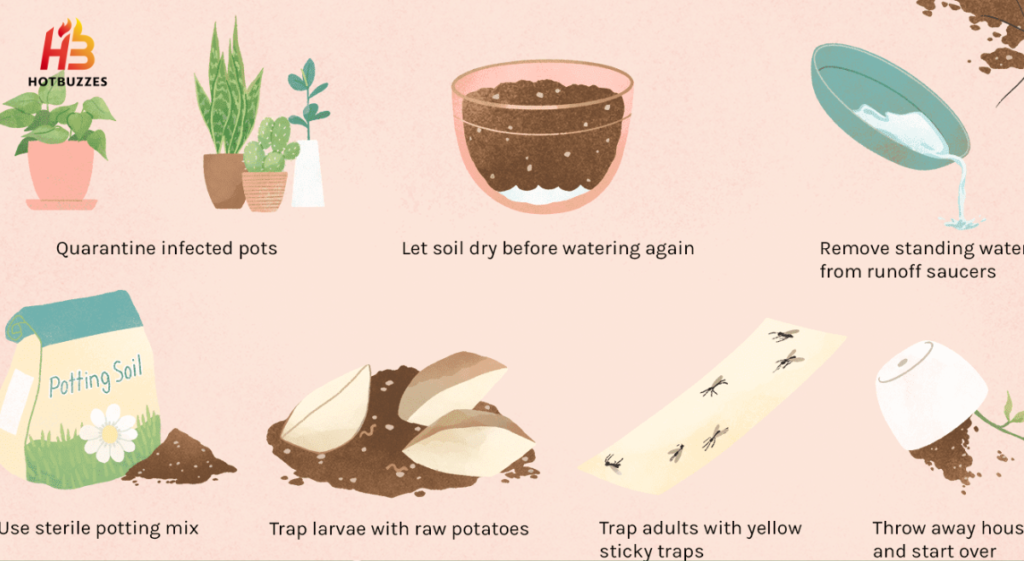
This is the first and most important step, and it does not cost anything. Colorado State University Extension states plainly that fungus gnats can be controlled by allowing the growing medium to dry out between watering. Dry soil is inhospitable to eggs and larvae.
When the top two to three inches of soil dry out, eggs cannot hatch, larvae cannot survive, and females have nowhere suitable to lay new eggs. Scotts Miracle-Gro recommends watering plants only when the top one to two inches of soil are dry and ensuring containers have proper drainage so water does not pool at the bottom.
This step alone will reduce the infestation significantly, but usually will not eliminate it on its own, especially if the gnat population is already large.

Step 2: Use Yellow Sticky Traps for Adults
Yellow sticky traps placed in or near the plant pot are the most reliable way to catch and kill adult gnats. Adult fungus gnats are attracted to the color yellow, and the sticky coating traps them when they land or fly near it. Protect your houseplants by recognizing the early symptoms of overwatering and taking the right corrective steps.
Scotts Miracle-Gro recommends cutting small yellow sticky traps and placing them on wooden stakes inserted into the soil close to the surface, where adults tend to crawl and fly. This positions the trap right at the level where the gnats spend most of their time. Here She Grows used sticky traps alongside other treatments and found them effective for monitoring progress.
Watching how many gnats the traps caught each day gave a clear picture of whether the population was declining. When the traps started coming up mostly empty, it was a sign the infestation was under control. Replace traps every one to two weeks or when they fill up.
Step 3: Treat the Soil with Mosquito Bits (BTi)
This is the method that plant care communities consistently rate as the most effective treatment for larvae, and it has solid scientific backing. Mosquito Bits and Mosquito Dunks contain a naturally occurring bacterium called Bacillus thuringiensis subspecies israelensis, usually abbreviated as Bti.
According to the Kansas State University Research and Extension paper on fungus gnat management, Bti is a microbial insecticide that is effective against first and second-instar larvae in particular, targeting them before they develop further.
The application method is simple. Here She Grows describes steeping four tablespoons of Mosquito Bits in a gallon of water for at least 30 minutes, straining out the bits, and then using that water to water the plants normally. The Bti-infused water soaks into the soil, where it is lethal to larvae but completely harmless to the plant, pets, and humans.
Olive and June Home used this method and noted a visible difference after the first application, though it took about eight repeat treatments over two months to fully eliminate the infestation. The key point from that experience: repeat applications every time you water for at least six to eight weeks to break through multiple generations of the lifecycle.
Step 4: Apply Hydrogen Peroxide Drench
Hydrogen peroxide is another highly effective larval treatment that works on contact. Learning with Experts recommends mixing one part 3% hydrogen peroxide with four parts water. Let the top layer of soil dry out completely, then thoroughly drench the soil with the solution.
The hydrogen peroxide kills larvae and eggs on contact. After fizzing briefly in the soil for about 30 seconds, it breaks down into oxygen and water, both harmless to the plant. This treatment can be used alongside Bti for a stronger combined effect, especially in heavy infestations. Apply it every time you water for two to three weeks, always allowing the soil to dry before reapplying.
Step 5: Top Dress the Soil with Sand or Diatomaceous Earth
Adding a physical barrier on top of the soil prevents female gnats from accessing the moist soil below to lay eggs. Scotts Miracle-Gro recommends adding a quarter inch of horticultural sand (not play sand) to the top of the soil. The dry, coarse surface is uninviting to egg-laying females and also dries out faster than standard potting mix, which discourages larvae from surviving near the surface.
STUMP Plants recommends diatomaceous earth (DE) as an alternative. DE is a white powder made from the fossilized remains of microscopic aquatic organisms. When gnats and larvae come into contact with it, the abrasive, sharp particles damage their outer layer, and they dehydrate and die.
The important rules for using DE are to buy food-grade DE rather than the type sold for swimming pools, and to reapply it after watering since moisture neutralizes its effectiveness until it dries out again. Learning with Experts tested DE as part of a multi-method treatment and found it effective at reducing larval numbers when combined with other approaches.
Step 6: Try the Apple Cider Vinegar Trap (for Adults)
For catching additional adult gnats, an apple cider vinegar trap is easy to make and costs almost nothing. Scotts Miracle-Gro describes the method: fill a shallow container with a quarter inch of apple cider vinegar and a few drops of dish soap, then cover tightly with plastic wrap and poke a few small holes in the top.
The gnats are attracted to the vinegar, crawl through the holes, and the dish soap breaks the surface tension, so they sink and drown. Lowe’s Home Improvement also recommends a similar trap using sugar, dish soap, and white vinegar mixed.
It is worth noting that different plant owners have mixed results with vinegar traps. Some find them very effective for catching adults; others report they catch few gnats. Used in combination with sticky traps and soil treatments, they add another layer of coverage that helps push the infestation toward zero.
How Long Does It Take to Get Rid of Fungus Gnats?
This is the question most people ask, and the honest answer is: longer than you expect. Because the lifecycle is four weeks long, and because eggs are invisible in the soil, you need to keep treating for at least four to six weeks after you first notice improvement. Stopping treatment early is the most common reason gnats come back.
STUMP Plants explains that, like most houseplant pests, getting rid of fungus gnats comes down to breaking the lifecycle, killing both adults and larvae after any remaining eggs have hatched. Like most insecticides and treatments, multiple applications over several weeks are needed to achieve that.

Here She Grows took about four weeks to feel like the battle was being won, and zero gnats at the four-week mark after committing to the full treatment approach. That timeline is typical of a moderately sized infestation.
How to Prevent Gnats from Coming Back
Once the infestation is gone, keeping it gone is much easier than dealing with it again.
Water less often. This is the single most effective prevention method. Garden Betty considers allowing soil to dry between waterings, the foundation of a gnat-free plant collection. Plants that are consistently moist are essentially standing invitations.
Check the new potting soil. Here She Grows notes that fungus gnats often arrive through new potting soil, even soil that looks clean and fresh. Inspect any new soil before use, and consider baking it in the oven at 180 degrees for 30 minutes to sterilize it if gnats have been a recurring problem.
Inspect new plants. Before bringing a new plant into your home, check the soil surface for signs of gnats or larvae. A potato chunk test works well for this: Press a small piece of raw potato into the soil, leave it for 24 hours, and then check the underside. If larvae are present, they will be attracted to the potato.
Use well-draining soil. Scotts Miracle-Gro recommends using potting mixes that do not contain large amounts of composted material and adding perlite to improve drainage if overwatering is a tendency. Less organic matter in the soil means less food for larvae if any do get in.
Remove fallen leaves and debris. Organic debris on the soil surface provides the perfect egg-laying spot. Keeping the soil surface clean and clear significantly reduces the attractiveness of the pot to female gnats looking for a place to deposit eggs.
Frequently Asked Questions
Q1: Are fungus gnats harmful to humans?
No. Adult gnats do not bite, sting, or carry diseases that affect humans. They are entirely a nuisance to people. The concern is the damage their larvae can cause to plant roots, especially in younger or smaller plants.
Q2: Why do I keep getting gnats even after treating the plant?
Almost always because the treatment is being stopped too early. Eggs and pupae in the soil are not killed by the same methods that kill adults and larvae, so new adults keep emerging. Continue treatment for at least six weeks after the visible population drops.
Q3: Can I use neem oil for fungus gnats?
Yes. Neem oil can be diluted and used as a soil drench to deter larvae. It works as a repellent and disrupts larval development, though it is generally considered less effective than Bti for eliminating an active infestation. It works best as a preventive measure.
Final Thoughts
Fungus gnats are one of those houseplant problems that feel impossible to solve until you understand the root cause. The root cause is almost always wet soil, and the solution is almost always a combination of fixing the watering routine and treating both the adults and the larvae at the same time.
Letting the soil dry out, using yellow sticky traps to catch adults, and treating the soil with Bti from mosquito bits are the three steps that, used together, eliminate even large infestations. Add hydrogen peroxide drenches or a top layer of horticultural sand for extra support, and you are covering every stage of the lifecycle.
The only real test of patience is time. Commit to six weeks of consistent treatment, resist the urge to stop when the gnats seem to disappear, and keep your watering in check going forward. Do all of that, and the gnats will not come back.

I started growing houseplants a little over 3 years ago with a single pothos cutting and a windowsill. Since then, my collection has grown to more than 40 plants (snake plants, ZZ plants, peace lilies, a couple of orchids). I’m still intimidated by, and one aloe that has survived three moves despite my best efforts to kill it.
I’m not a botanist or a certified horticulturist, I’m a hobbyist who’s made most of the beginner mistakes so you don’t have to: overwatering, underwatering, ignoring root rot until it was too late, and putting a sun-loving plant in the darkest corner of my apartment. HotBuzzes is where I share what I’ve actually learned from keeping plants alive (and occasionally failing), along with research from reliable sources to back it up.