
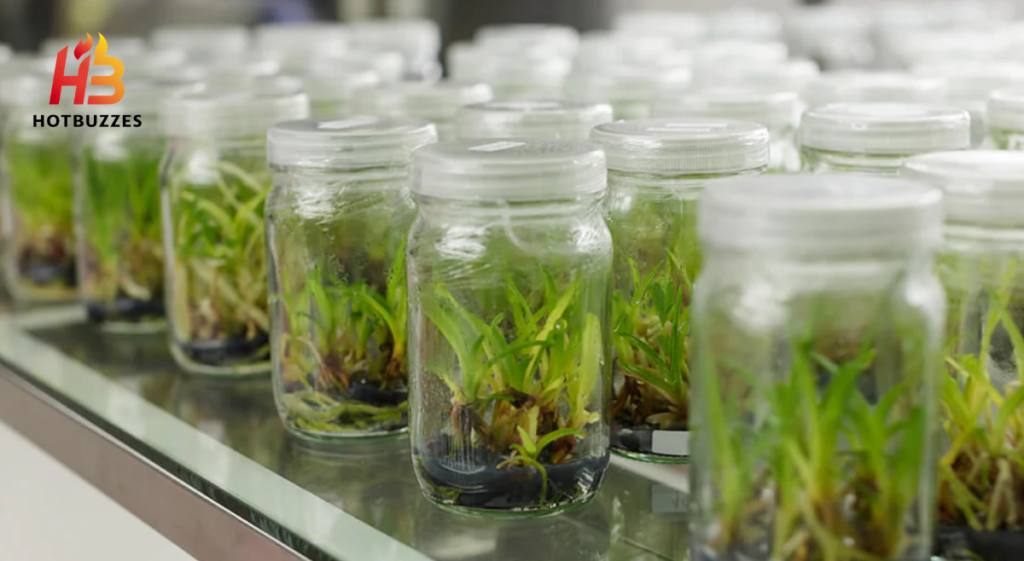
Tissue culture propagation is a way of growing new plants from a very small piece of a parent plant, a process explained in detail on Wikipedia. This small piece is called an explant. It can be a leaf, a bud, a piece of stem, or even a single cell. The explant is placed inside a jar or a test tube that has a special food mixture called a nutrient medium.
This medium has sugar, vitamins, minerals, and plant hormones. Everything is kept clean and free from germs. Under these conditions, the small piece of plant tissue grows into a full plant. This is also called micropropagation because it starts from a very tiny bit of tissue.
Many people ask this question in online plant-growing communities: how can one small leaf turn into hundreds of full-grown plants? The answer lies in a natural ability that plant cells have. Plant scientists call this totipotency. It means that almost every living plant cell has the full set of instructions needed to grow into a complete new plant, if it gets the right conditions. Tissue culture simply gives the cells the right conditions in a lab.
How Tissue Culture Propagation Works
The process usually happens in a few clear stages.
Stage one is initiation. A small piece of healthy plant tissue is chosen. It is cleaned carefully with chemicals to remove any germs, fungus, or bacteria on its surface. This step is very important because even one unwanted microbe can spoil the whole culture. The cleaned tissue is then placed on the nutrient medium inside a sterile jar.
Stage two is multiplication. Once the tissue starts growing, it forms small shoots or a mass of cells called callus. This callus or shoot tissue is divided again and again and placed onto fresh medium. Each division can create new shoots. This is the stage where one small piece can multiply into hundreds or even thousands of copies over a few months.
Stage three is rooting. The small shoots are moved to a different medium that has hormones that help roots to grow. Once roots appear, the young plant looks like a tiny seedling with both a shoot and a root system. Discover the rare houseplants that collectors are adding to their wish lists in 2026.
Stage four is hardening. This is the step where the lab-grown plantlet is slowly introduced to the outside world. It is first kept in a humid greenhouse or net house because it has grown inside a jar with high moisture and no direct sunlight. Slowly, the humidity is reduced, and the plant gets used to normal air and light. After this hardening period, the plant is strong enough to be planted in soil like any other plant.
Types of Plant Tissue Culture
There are different pathways that scientists use, depending on the plant and the goal.

1. Shoot tip or meristem culture:
This method uses the tip of a shoot or bud, known as the meristem. Here, cells divide rapidly and develop into new tissue. The growing tip is usually virus-free, allowing healthy plants to be produced even when the parent plant is infected.
This method is often used for crops like potato, sugarcane, and banana, where farmers need clean planting material year after year. It has also been used to conserve endangered plants. Researchers in the journal Scientia Horticulturae used meristem culture on a rare plant called Hosta capitata. This ensured the plants remained virus-free and genetically stable, helping protect the species for future generations.
2. Organogenesis:
This pathway forms new shoots and roots directly from plant tissue or from a callus, which is an unorganised mass of plant cells that grows on the nutrient medium. Scientists of PMC, Auxin–Cytokinin Interaction Regulates Meristem Development, control this process by adjusting the balance of two plant hormones, auxin and cytokinin. Keep your orchids healthy and blooming with this easy beginner-friendly care guide.
A higher level of cytokinin usually encourages shoot formation. A higher level of auxin encourages root formation. This method is widely used for ornamental plants and vegetables. It allows growers to direct the tissue to produce exactly the part they need, whether shoots first or roots first. This traces back to a classic 1957 finding by researchers Skoog and Miller, still cited today as the foundation for this technique.
3. Somatic embryogenesis:
Here, scientists grow structures called somatic embryos from normal plant body cells instead of fertilized seeds. These structures look and behave like real seeds. Each somatic embryo has both a shoot end and a root end. This allows it to grow into a complete plant on its own, much like a real seed.
This method is useful for producing large numbers of plants quickly. It is widely used in plant breeding and automated production systems. In a study, Vegetos, High Speed Regeneration via Somatic Embryogenesis in Elite Indian Banana cv. Somrani monthan on an Indian banana variety, about seventy percent of the somatic embryos developed into full plantlets. After the hardening stage, eighty-two percent of those plantlets survived successfully in the nursery.
Real Life Example: Bananas in India
Bananas are one of the best real-world examples of tissue culture propagation in action. Banana plants do not grow well from seeds, so farmers traditionally used suckers, which are small side shoots taken from a mature banana plant. This method is slow and can spread diseases from one generation to the next.
Tissue culture solved many of these problems. Today, tissue culture-derived banana plants make up more than thirty percent of the total banana production in India. That is a huge shift from traditional planting methods in just a few decades.
However, there is still a long way to go. According to a research study, India would need around nine hundred million tissue culture banana plantlets every year to bring even one third of its banana growing land under this technology. At present, production is only somewhere between forty and eighty million plantlets a year. This gap shows both the popularity of the technology and how much room there still is for growth.
Prices also tell a story. A tissue culture banana plant in India generally costs much more than a traditional sucker. Traditional suckers for one acre might cost around ten to eighteen thousand rupees, while tissue culture plants for the same area could cost thirty to forty-five thousand rupees.
Even with this higher starting cost, many farmers choose tissue culture plants because they produce higher yields, more uniform fruits, and mature earlier. Farmers in regions like Jalgaon and Anand have reported strong profits per acre once the crop matures. These profits are especially noticeable from the second year onward, when the plants produce a ratoon crop.
Real Life Example: Southeast Asia and Disease Resistance
Another well-documented case comes from Southeast Asia. For years, a fungal disease called Fusarium wilt, also known as Panama disease, was destroying banana plantations in this region. Farmers who continued using suckers from infected plants often spread the disease further, since the disease can travel through planting material.
Tissue culture became a key tool for fighting this problem. It produces disease-free banana plantlets on a large scale. According to data shared by the Food and Agriculture Organization in 2022, tissue culture banana plantlets increased annual banana production by thirty-five to forty percent in the Philippines and Indonesia over five years. This is a clear real-world example of how a laboratory technique reached ordinary farms and made a measurable difference to food production.
In the Philippines, tissue culture went a step further than just producing clean plantlets. Scientists at the Philippine Council for Agriculture, Aquatic and Natural Resources Research and Development developed Giant Cavendish Tissue Culture Variants, known as GCTCV 218 and 219, using tissue culture methods.
\These are Cavendish banana lines that showed real resistance to the disease in field trials, with GCTCV 219 in particular standing out for its strong resistance to Fusarium wilt while still producing a marketable yield of around 18 kilograms per bunch. This shows that tissue culture is not only used to multiply healthy plants quickly, but it is also used as a breeding tool to develop entirely new disease-resistant varieties that farmers can plant with more confidence.
Real Life Example: The Global Market
Tissue culture propagation is not just a scientific idea kept in universities. It has grown into a real business. Market research reports from Coherent Market Insights estimate that the global plant tissue culture market could reach around eight hundred and eighty-three million US dollars by 2031.
North America has historically held the biggest share of this market, at close to thirty-nine percent, though Asia Pacific countries like India and China have been expanding their own tissue culture facilities quickly to support local crop production. Add instant style to your home with eye-catching plants that require very little maintenance.
The floriculture industry, which deals with flowers and ornamental plants, is another area where tissue culture plays a big role. According to The Daily Upside, the global trade of flowers and ornamental plants is worth close to thirty billion US dollars a year, and countries such as the Netherlands, China, India, and Kenya are leading producers.
Orchids are a good example within this industry. According to Wikipedia, orchids are naturally hard to grow from seed because their seeds lack the stored food that most other seeds have.
Tissue culture makes it possible to produce large numbers of identical, healthy orchid plants, which is one reason orchids are commonly available and affordable in markets today, even though wide varieties are naturally slow-growing and delicate.

Advantages of Tissue Culture Propagation
There are several reasons why this method has become so popular across the world.
- It produces exact copies of a good plant. If a particular plant has strong resistance to disease, tasty fruit, or beautiful flowers, tissue culture can make thousands of identical copies of that same plant.
- It saves space and time. Traditional propagation from seeds or cuttings needs a lot of land and time to produce large numbers of plants. Tissue culture can produce many plantlets in a small lab space within a few months.
- It helps in producing disease-free plants. Since the process happens in sterile conditions, and since meristem tissue rarely carries viruses, tissue culture plants are usually healthier than plants grown by older traditional methods.
- It allows propagation of plants that do not produce seeds easily or plants that are difficult to grow through cuttings.
- It also plays an important role in modern genetic research. Scientists use tissue culture along with gene transfer tools, such as Agrobacterium, to create genetically modified plants and then regenerate whole plants from the modified cells.
Disadvantages of Tissue Culture Propagation
Even though tissue culture has many benefits, it also comes with certain challenges, which many farmers discuss openly in forums and community discussions online.
- The starting cost is higher compared to traditional propagation methods, as we saw with the banana example. Setting up a proper lab with sterile equipment, trained staff, and climate-controlled rooms requires investment.
- Contamination is a constant risk. Even a tiny amount of fungus or bacteria in the culture jar can destroy the whole batch of plantlets.
- Some farmers in developing regions have been slow to adopt tissue culture, partly due to a lack of awareness and partly due to limited access to certified tissue culture nurseries.
- Studies among smallholder farmers, including in parts of Uganda, have shown that while many farmers agree that tissue culture bananas give better yield and cleaner planting material, government and private support systems are not always strong enough to help every farmer adopt the technology.
- Another point that is sometimes raised is genetic uniformity. Since tissue culture produces exact clones, a large field planted only with tissue culture plants of a single variety can be more vulnerable if a new disease appears that affects that particular variety.
Why Choose Tissue Culture over Conventional Techniques
Conventional propagation methods like cuttings, suckers, and seeds have worked for centuries, but they come with real limits. Research and field data show clear, measurable gaps between the two approaches.
Maturity time: Tissue culture banana plants reach maturity in about 12 to 16 months, compared to 2 to 3 years for conventionally propagated banana plants, according to data published by ISAAA (International Service for the Acquisition of Agri-biotech Applications).
Yield per hectare. The same ISAAA data shows tissue culture banana crops producing 40 to 60 tons per hectare annually, compared to only 15 to 20 tons per hectare from conventional planting material. That is roughly two to three times more yield from the same land.
Bunch weight. Tissue culture banana plants also produce heavier bunches, in the range of 30 to 45 kilograms, compared to 10 to 15 kilograms from conventionally grown plants, as reported by ISAAA.
Multiplication rate. Conventional methods depend on the plant’s natural rate of producing suckers or cuttings, which is slow and limited by season. Tissue culture removes this limit. Research on Aloe vera micropropagation recorded a multiplication ratio of about 1 to 4 every 4 weeks, meaning one shoot can become 4 new shoots in a single month, a rate that compounds quickly over several cycles.
Disease and uniformity: A ScienceDirect overview on plant tissue culture notes that traditional micropropagation allows rapid production of disease-free and uniform planting material in a short period, something conventional propagation struggles with, since diseases can carry over through suckers, cuttings, or infected seed stock.
Land and seasonal independence
Conventional propagation depends on land availability, favourable weather, and the right growing season. Tissue culture happens in a controlled lab environment, so production is not limited by climate, season, or field space, allowing continuous year-round output.

Frequently Asked Questions
Is tissue culture the same as cloning a plant?
Yes, in a way it is. Since every plantlet grown from the same explant carries the same genes as the parent plant, tissue culture is a form of cloning. This is why a farmer can grow thousands of banana plants that are all identical to one good parent plant.
Can tissue culture be done at home without a lab?
Basic experiments are possible with clean tools and simple sterilisation at home, and many hobbyists try small setups with things like orchid seeds or houseplant cuttings. However, commercial-scale tissue culture needs a proper sterile lab, controlled temperature, and trained hands, because even a small mistake can lead to contamination and loss of the whole batch.
Why do tissue culture plants cost more than normal plants?
The higher price comes from the lab work involved. Cleaning the tissue, preparing nutrient media, maintaining sterile rooms, and paying trained staff all add to the cost. Even though the starting price is higher, many farmers still prefer tissue culture plants because they give higher yields, mature faster, and stay healthier over time.
Final Thoughts
Tissue culture propagation has moved far beyond the research lab and into real farms, nurseries, and flower markets around the world. The banana industry in India, the fight against Fusarium wilt in the Philippines and Indonesia, and the growing global market for tissue culture plants all show that this technology brings real, measurable benefits to farmers and growers.
At the same time, the higher starting cost, the risk of contamination, and the need for proper training mean that it is not a perfect solution for everyone. For anyone thinking about using tissue culture plants, whether for a small nursery or a large farm, it helps to weigh these advantages and disadvantages carefully and start with a trusted, certified supplier.

Ali Hassan is a plant enthusiast and content writer who creates practical, easy-to-follow articles about plant care, gardening, and indoor plants. He combines thorough research with reliable horticultural resources to provide accurate, beginner-friendly advice. His goal is to help readers grow healthier plants and make plant care simple, enjoyable, and accessible for everyone.