
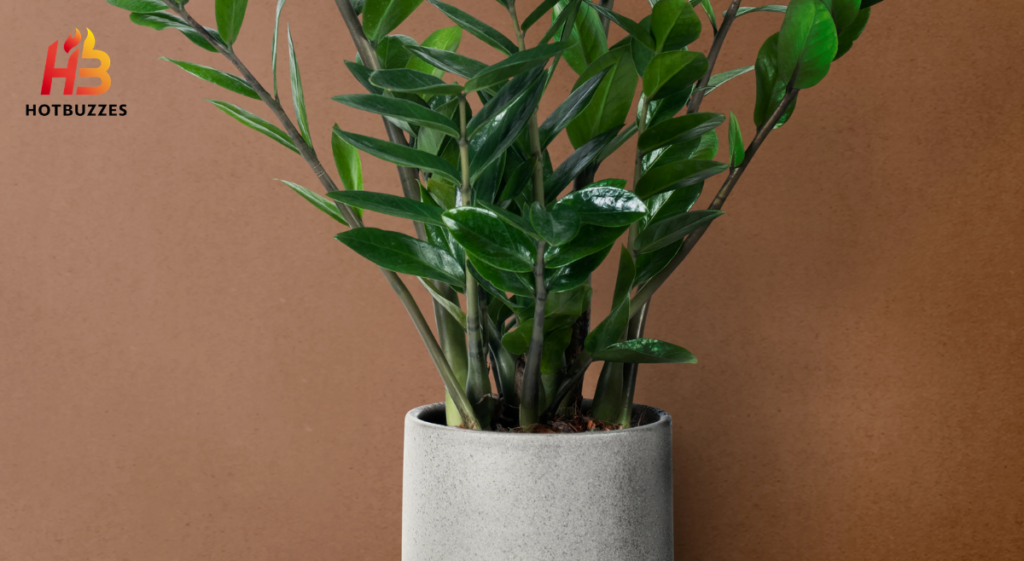
If you have ever walked into a home, office, or cafe and noticed a plant with dark, glossy leaves sitting in a corner looking absolutely perfect, there is a good chance it was a ZZ plant. These plants have a reputation that follows them everywhere; they are nearly impossible to kill, they look good in almost any space, and they ask for very little in return.
For anyone just starting with houseplants, the ZZ plant is one of the best choices. This guide covers everything a beginner needs to know, from where the plant comes from to how to water it, feed it, and keep it looking its best for years.
| Botanical name | Zamioculcas zamiifolia |
| Common names | ZZ plant, Zanzibar gem, Zuzu plant |
| Light needs | Low light plant: tolerates shade |
| Watering | Drought-tolerant: water every 2 to 3 weeks |
| Soil type | Well-draining soil or cactus potting mix |
| Growth rate | Slow growing: a few new stems per year |
| Mature size | 2 to 4 feet tall indoors |
| Toxicity | Toxic to pets and humans if eaten |
| Hardiness | USDA hardiness zones 9 to 12 outdoors |
| Air benefits | Air purifying plant |
What Is a ZZ Plant?
The ZZ plant’s full scientific name is Zamioculcas zamiifolia, which is a mouthful, which is exactly why most people just call it the ZZ plant. It also goes by other names, including Zanzibar gem, eternity plant, zuzu plant, aroid palm, and emerald palm.
According to Wikipedia, the ZZ plant is a tropical herbaceous perennial that belongs to the Araceae family, the same plant family as peace lilies and monstera. It has thick, upright stems lined with oval, waxy leaflets that start as a bright lime green and deepen into a rich emerald as they mature. Below the soil, it grows large, bulbous, potato-like structures called rhizomes. These rhizomes are the secret behind how this plant survives so well with so little care.
Wikipedia also notes that the leaves of a ZZ plant contain 91% water and the petioles (leaf stalks) contain 95% water. The plant essentially carries its own water supply, which is why it handles drought so well. Find out how to water, light, and care for your snake plant to help it thrive indoors.
Where Does the ZZ Plant Come From?
Understanding where a plant comes from helps you understand what it actually needs. The ZZ plant is native to eastern Africa, growing naturally in countries including Kenya, Tanzania, Mozambique, Malawi, Zimbabwe, and South Africa. According to Wikipedia’s entry on Zamioculcas, it grows in dry forests, grasslands, and bushland environments that experience long dry seasons with irregular rainfall.
This background explains everything about how the plant behaves. It evolved to store water in its rhizomes, grow slowly, tolerate shade under forest canopies, and survive long stretches without rain. That is not a plant that wants to be fussed over. It wants to be left alone most of the time, which is great news for busy people.

The plant was first recorded in a botanical publication in 1829 and was commercially propagated by Dutch nurseries starting around 1996, according to Healthy Houseplants. Since then, it has spread to homes and offices all over the world. It became especially popular over the last decade, partly because of how well it photographs and partly because it genuinely thrives in indoor spaces where most other plants struggle.
A writer for Brooklyn Botanic Garden described their experience buying two ZZ plants for their apartment and noted that after a few months, both were alive, well, and even showing new growth, which is exactly the kind of experience most beginners have with this plant.
Light Requirements
One of the most common questions beginners ask is how much light a ZZ plant needs. The short answer is: not much, but some is better than none. According to The Old Farmer’s Almanac, ZZ plants can grow in nearly full shade to bright indirect light, but they will scorch in full sun locations. Lower light causes them to grow more slowly, but they will still survive.
Wikipedia adds that insufficient light can result in leaves lengthening, yellowing, and generally uneven growth as the plant stretches toward a light source. So while the plant can handle a dim corner, it does better near a window with indirect light coming in.
The ideal spot is near a north or east-facing window where the plant gets soft, filtered light throughout the day without any direct sun hitting the leaves. If the only space you have is further from a window, the plant will manage, just expect slower growth and slightly less vibrant leaves.
One thing plant owners discover on gardening forums is that ZZ plants actually do well under artificial fluorescent lighting, which is why they became so popular in offices. This makes them one of the few houseplants that can genuinely thrive in a workspace with no natural light nearby.
Watering Guide
Watering is where most beginners go wrong with ZZ plants, and almost always in the same direction, too much. Bloomscape’s care guide puts it simply: water only when the soil volume is completely dry. Not halfway dry, not slightly dry, completely dry all the way through. From there, water until liquid flows out of the drainage hole at the bottom of the pot, then discard any water that collects in the saucer.
The Old Farmer’s Almanac compares the ZZ plant to cacti and succulents in terms of watering. In summer, that might mean watering once every two weeks. In winter, it could be as little as once a month. The reason for this is the rhizome system underground. Those thick, potato-like roots store water the plant can draw from whenever it needs it.
When you overwater, the rhizomes sit in wet soil and begin to rot. Once root rot starts, the plant struggles to absorb anything from the soil, water, or nutrients; nothing gets through. Overwatering is cited across every major plant care resource as the number one reason ZZ plants fail.
A practical tip shared widely in plant care communities: do the finger test before watering. Push your finger about two inches into the soil. If it feels even slightly moist, put the watering can down and come back in a few days. Only water when that two-inch depth feels completely dry.
Warning for Users
Avoid allowing the plant to stand in water. This is because the roots can suffer from root rot as a result of too much water. Use a pot that has holes. After each watering, remove the water from the saucer. Grow new pothos plants at home with this easy water propagation technique that anyone can follow.
Soil and Potting
Because root rot is the biggest risk with ZZ plants, the soil you use matters quite a bit. According to Gardener’s Supply, well-drained, aerated soil is essential. A standard potting mix combined with perlite or sand prevents waterlogging and gives the rhizomes room to breathe. The goal is soil that drains fast and does not hold moisture for too long after watering.
Wikipedia notes that for indoor plants, a well-drained potting soil mix is the way to go. In its natural habitat, the ZZ plant grows in sandy, nutrient-poor soils, so it does not need anything particularly rich or special.
Always use a pot with drainage holes. Without drainage, water sits at the bottom of the pot, and the rhizomes have no escape from it. No matter how well you manage your watering schedule, a pot without drainage will eventually cause problems.
ZZ plants grow slowly and do not need repotting often. Gardener’s Supply recommends checking the roots. When they start twisting around each other or poking out of the drainage hole, it is time for a slightly larger pot.
Temperature and Humidity
This is one area where ZZ plants are extremely forgiving. According to Wikipedia, the best growth happens between 18 and 26 degrees Celsius (64 to 79 degrees Fahrenheit). The plant can survive outdoors as long as temperatures do not fall below 15 degrees Celsius (60 degrees Fahrenheit). For most homes, this means the ZZ plant is perfectly comfortable in standard room temperatures year-round.
The Old Farmer’s Almanac points out that temperatures below 45 degrees Fahrenheit can be fatal, and the plant should be kept away from cold or drafty windows. If you move houseplants outdoors in summer, bring the ZZ plant back inside once temperatures consistently drop 60 degrees Fahrenheit below.
As for humidity, ZZ plants are not fussy at all. Bloomscape states that this plant does fine in average household humidity and does not need misting or a humidifier. The waxy coating on its leaves helps it retain moisture in drier air.
Fertilizing
ZZ plants grow slowly, and they come from nutrient-poor soils, so they genuinely do not need much fertilizer. Gardener’s Supply says that having evolved in sandy, nutrient-poor soils, ZZ plants generally have no serious need for fertilizer.
If you want to feed yours, use a balanced water-soluble fertilizer diluted to half strength every two to three months during the growing season, spring and summer only.
Gardenista recommends a balanced liquid fertilizer with equal nitrogen, phosphorus, and potassium (something labeled 20-20-20) applied once a month while watering during the growing season.
Do not fertilize in fall and winter. The plant is in a slower growth phase and does not need or use extra nutrients during that time. Feeding a dormant plant can build up salts in the soil and actually cause more harm than good.
Pruning and Cleaning
Those glossy leaves are one of the ZZ plant’s best features, but they are also magnets for dust. Dust sitting on the leaves blocks light and makes photosynthesis less efficient. Every few weeks, wipe each leaf with a slightly damp cloth. This keeps the leaves shiny, removes dust, and also gives you a chance to check the undersides for any early signs of pests. Soltech’s care guide makes this a key part of regular ZZ plant maintenance.
Pruning is minimal. Gardener’s Supply recommends removing any yellow or damaged leaves with clean scissors or pruning shears. This keeps the plant looking tidy and redirects energy toward healthy growth. One thing worth knowing: ZZ plant sap can irritate skin. Wear gloves when pruning or handling the plant for extended periods, and wash your hands afterward.
Toxicity
This is important for anyone with pets or young children. The ZZ plant contains calcium oxalate crystals throughout all parts of the plant, leaves, stems, rhizomes, and sap. According to Gardenista, the plant is toxic but not cancerous (there were false rumors in the 2010s claiming it caused cancer, which have since been thoroughly disproven).
The actual risk is irritation, burning in the mouth, nausea, or skin irritation if sap contacts sensitive skin. Keep the plant out of reach of cats, dogs, and small children who might chew on the leaves. For adults handling the plant normally, washing hands after touching it is enough of a precaution.

Air Purifying Properties
The ZZ plant has real, documented air-purifying benefits. A study from the University of Copenhagen’s Department of Plant and Environmental Science found that the ZZ plant was capable of removing significant amounts of xylene, toluene, benzene, and ethylbenzene from the air. These are chemicals commonly found in indoor environments, such as paints, cleaning products, and furniture.
Healthy Houseplants also notes that NASA has studied the ZZ plant along with many other houseplants and confirmed its effectiveness at removing harmful chemicals, including xylene and benzene, from indoor air. This makes the ZZ plant not just a decorative plant but a genuinely useful one for improving indoor air quality.
Propagating a ZZ Plant
Once you have a healthy ZZ plant, it is easy to grow more from it. There are two main methods.
- The first is division, when you repot the plant, gently pull the rhizomes apart and plant them in separate containers. Each section with a rhizome will grow into a new plant. This gives instant results, and the new plants grow quickly because they already have an established root system.
- The second method is leaf cuttings. Snip a leaf as close to the stem as possible and place the base into moist soil. Wikipedia notes that a bulb-like structure should form at the base over time, but this process can take upwards of one year. It requires more patience than division, but it is a good option if you do not want to disturb the main plant.
- Spring and early summer are the best times to propagate, as the active growing season supports faster recovery and root development.

Tips for Beginners
- Use a pot with holes for drainage to avoid root rot.
- Water less frequently than you think. If in any doubt, don’t water.
- To get the best colour of leaves, place them in indirect light.
- Avoid relocating the plant too many times as this will take time for it to acclimate itself to new surroundings.
- The shiny leaves should be wiped once a month to keep them dust-free and shiny.
- Avoid fall or winter fertilization.
- When repotting or propagating the plant, wear gloves.
Common Issues & Solutions
- Yellow leaves: Almost always a watering issue. If the leaves are soft and mushy, along with being yellow, overwatering and root rot are the causes. If they are yellow and the soil is bone dry, the plant has been underwatered for too long. Adjust your watering schedule and make sure the pot drains properly.
- Drooping or wrinkled stems: Soltech points to extreme underwatering or insufficient light as the main causes. Water the plant thoroughly and consider moving it to a brighter spot.
- Brown leaf tips: Usually caused by very dry air or inconsistent watering. Keep the plant away from direct air conditioning or heater vents.
- Slow growth: Urbane Eight’s care guide notes that slow growth is caused by low light or infrequent feeding. Moving the plant to a brighter spot and fertilizing occasionally during the growing season helps encourage new growth.
- Pests: ZZ plants are generally resistant to pests but can occasionally attract mealybugs, scale, or spider mites. Wipe leaves with a damp cloth and apply neem oil or insecticidal soap if pests appear.
Toxicity Warning
Note: Poisonous to Dogs and Cats. The ZZ plant is poisonous to pets like cats and dogs and to humans, due to calcium oxalate crystals. All parts of the plant contain calcium oxalate crystals that may cause mouth irritation, nausea, and stomach discomfort if ingested. The sap is mildly irritating to the skin. Always wash your hands after handling the plant. Out of Reach of Children and Animals.
Frequently Asked Questions
How long does a ZZ plant live indoors?
A healthy ZZ plant can live for 10 years or even longer when provided with proper care. Because it is highly tolerant of low light, drought, and indoor conditions, it is considered one of the longest-living houseplants for beginners.
Why is my ZZ plant not growing?
Slow growth is completely normal for a ZZ plant. It naturally produces only a few new stems each year. However, growth may become even slower if the plant is kept in very low light, exposed to cold temperatures, or lacking nutrients during the growing season.
Can a ZZ plant survive in a room with no windows?
A ZZ plant can tolerate low-light conditions better than most houseplants, but it cannot survive indefinitely in a completely dark room. All plants need some light for photosynthesis.
Conclusion
The ZZ plant is one of the most tolerant houseplants you can own. It will withstand some shade, occasional dry-out, and dry air. It has bright foliage and can be a year-round beauty with minimal care. Adopting just two easy-to-follow principles, not overwatering and avoiding direct sunlight, will pay off for the plant owner in many years of lush green life, with the proper soil and pot and a little patience.
The ZZ plant is a versatile plant that can be used in a variety of settings, such as desks, shelves, or corners of living rooms. For beginners who often struggle to keep houseplants alive, the ZZ plant offers an excellent starting point. Its ability to tolerate occasional neglect, low-light conditions, and infrequent watering makes it one of the most forgiving indoor plants available.
With basic care and a suitable growing environment, it can remain healthy and attractive for many years, making it a reliable choice for homes, offices, apartments, and other indoor spaces.

I started growing houseplants a little over 3 years ago with a single pothos cutting and a windowsill. Since then, my collection has grown to more than 40 plants (snake plants, ZZ plants, peace lilies, a couple of orchids). I’m still intimidated by, and one aloe that has survived three moves despite my best efforts to kill it.
I’m not a botanist or a certified horticulturist, I’m a hobbyist who’s made most of the beginner mistakes so you don’t have to: overwatering, underwatering, ignoring root rot until it was too late, and putting a sun-loving plant in the darkest corner of my apartment. HotBuzzes is where I share what I’ve actually learned from keeping plants alive (and occasionally failing), along with research from reliable sources to back it up.