
Basil is simultaneously one of the most popular herbs and one of the most commonly killed. Not because it is difficult; it is not, but because most people get two specific things wrong and everything else right. They give it too little light or too much water, and either mistake is enough to end a basil plant within weeks.
According to OurGardenWorks’ May 2026 complete basil growing guide, basil is the herb most home cooks wish they had more of. A bunch from the grocery store costs money, wilts in three days, and tastes like a pale memory of what fresh basil can be. A single well-maintained basil plant produces more than most households can use all season for almost nothing. The challenge is not the plant. The challenge is understanding what it needs and what it absolutely cannot tolerate.
This guide addresses that challenge directly. Understanding basil problems explains why the plant dies in specific ways. Fixing each issue as it appears helps restore healthy growth. Building a proper routine also keeps a single plant producing usable leaves for months rather than weeks.
Why Basil Behaves Differently From Every Other Common Herb
Basil’s biology explains its specific vulnerabilities. Understanding the plant before setting up care conditions makes every subsequent decision more logical. The Old Farmer’s Almanac’s September 2025 guide to growing basil indoors identifies basil’s native origin as the critical context: it is a tropical plant native to Central Africa, India, and Southeast Asia. This is not a cold-tolerant Mediterranean herb like rosemary or thyme. It evolved in conditions of intense tropical heat, consistent warmth, and high humidity. Every care requirement follows from this tropical origin.
Window Harvest’s June 2026 basil care guide builds on this directly: temperature matters as much as moisture. Basil wilts and sulks below 50 degrees Fahrenheit (10 degrees Celsius). It is happiest at 65 to 85 degrees Fahrenheit (18 to 29 degrees Celsius). Find the perfect herbs for your kitchen windowsill and enjoy homegrown flavor every day.
Significance:
The significance of this temperature sensitivity is specific to indoor growing. Cold glass in winter can damage basil within hours. Cold drafts from gaps in window frames can also cause problems. Air conditioning vents in summer are another common cause of damage. Placing a basil plant directly against a cold window at night can also harm it. A healthy basil plant at 8 p.m. can develop dark, water-soaked leaf patches by morning from overnight contact with cold glass. This damage is irreversible in the affected leaves.
Basil is also unlike most herbs in that it is an annual. It is a plant that completes its entire lifecycle within one growing season. Its biological goal is to produce leaves, flower, set seed, and die. Every management decision the grower makes is essentially working against the plant’s natural lifecycle. It delays the flowering stage to extend the leaf-producing stage that is actually useful for cooking. Understanding this helps explain why the techniques that work for basil are more active than those needed for perennial herbs like thyme or chives.
The Exact Light Threshold Where Basil Succeeds or Fails
The most common reason indoor basil fails is not receiving enough light to maintain healthy, flavourful leaf production. The specific threshold is higher than most people realise. The consequences of falling below it appear slowly. Many growers do not connect the plant’s gradual decline to its light conditions.

Blooming Expert’s May 2026 indoor-outdoor basil guide provides the most technically precise light guidance available from a consumer-facing source. A south-facing window works for indoor basil only in USDA zones 8 through 10, where winter sun angles remain high. In zones 3 through 7, winter sun angles drop too low. Day length also becomes too short. These zones cover most of the UK, northern Europe, Canada, and much of the US. As a result, basil does not receive the daily light integral it needs. The result is pale, stretched, flavour-poor growth.
PAR Value:
The PAR value, or photosynthetically active radiation, measures the light plants can actually use for photosynthesis. At the canopy level, the required range is 200 to 400 µmol/m²/s. Blooming Expert confirms that most herb-rated LED grow lights available for under thirty pounds deliver this range. They achieve it when placed six to ten inches from the plant.
OurGardenWorks gives the practical translation. Position a basic LED grow light four to six inches above the plant. Run it for fourteen to sixteen hours a day. It can produce results equal to or better than an outdoor plant in summer. This is the recommended approach if you do not have a strong south window.
Healthy Houseplants’ 2025 indoor basil guide identifies four light adjustment techniques for suboptimal natural light. Use full-spectrum LED grow lights to supplement natural light. Rotate the plant regularly to ensure even light distribution. Use sheer curtains to filter intense direct light if leaf scorching occurs. Consider using reflective surfaces to increase light exposure in low light areas. A small mirror or white card placed behind the plant reflects available light onto the rear leaves. It is a zero-cost improvement that is genuinely effective in rooms with limited window access.
The diagnostic reading comes from the leaves themselves. Bright lime green, dense, aromatic leaves with no obvious leaning toward the window mean adequate light. Pale yellowy green, thin, widely spaced leaves reaching toward the window mean inadequate light. Once the diagnosis is confirmed, move the plant to a brighter position or add supplemental light immediately. Do not wait to see if the plant improves on its own.
Moisture Management: The Most Common Reason Basil Dies
Basil death by water is one of the most frequently documented experiences of anyone who has tried to grow it indoors, and it happens in both directions, though overwatering is significantly more common and more damaging. OurGardenWorks names the two primary killers with equal weight: not enough sun or too much water. Window Harvest gives the yellowing leaves a diagnostic: usually overwatering, poor drainage, or nitrogen deficiency. Check that the pot drains freely and you are not watering on a fixed schedule regardless of actual soil moisture.
Daily Finger Test:
The daily finger test is the most reliable watering indicator for basil. Smart Gardenist’s August 2025 basil guide specifies: check the soil daily by touching the top inch. If it feels dry, it is time to water. Container-grown basil typically needs watering every two to three days, but this can vary significantly depending on the pot material, the amount of sunlight the plant receives, and the ambient temperature of the kitchen.
The two-to-three-day estimate from Smart Gardenist is a starting point for actively growing basil in a warm, bright environment. In lower light or cooler conditions, the same plant may only need watering every five to seven days. The finger test removes the need to estimate because it reports the actual soil condition rather than requiring the grower to track elapsed time.
Cultivated Earth’s February 2026 basil guide gives the physical setup that prevents water-related problems from the start: a medium-sized pot six to eight inches in diameter with drainage holes, a high-quality lightweight potting mix designed for indoor herbs, and a saucer under the pot to catch excess water. The drainage hole is genuinely non-negotiable for basil. OurGardenWorks is direct about the consequence of a sealed pot: basil sitting in water even briefly develops root rot.
Minimum pot size is also more specific for basil than for most herbs. OurGardenWorks specifies a minimum six-inch pot for a single Genovese plant and a four-inch pot for compact dwarf varieties. Basil in a pot that is too small dries out within hours on a hot windowsill. It becomes repeatedly stressed. A larger soil volume provides greater thermal mass. It buffers against rapid drying. It also prevents the boom-and-bust moisture cycling that weakens roots over time.
Underwatering:
Underwatering produces a different but equally visible symptom: sudden dramatic wilting. Basil wilts quickly and dramatically when dry, far more noticeably than most herbs. The good news is that this wilting is fully reversible if caught within a few hours. Water immediately and thoroughly, and basil typically returns to its full upright position within 30 to 60 minutes. Repeated severe wilting, however, does cause cumulative root stress that makes the plant more susceptible to disease and slows recovery from each subsequent episode.
The Bolting Trigger: What Sets It Off and How to Delay It
Bolting, the transition from leaf production to flower production, is the process that ends the productive phase of any basil plant. Understanding what triggers it allows you to manage the conditions that accelerate it and extend the leaf-harvesting period significantly.
Blooming Expert provides the most scientifically accurate explanation of the bolting trigger available from a consumer herb guide: the plant’s signal to bolt is a combination of photoperiod, day length, and heat, both telling it that its growing season is ending and it should reproduce before dying. Leaves that remain after bolting become noticeably bitter as the plant cannibalises flavour compounds to fuel seed development.
Two-Factor:
This two-factor trigger explains something that confuses many indoor basil growers. A basil plant can bolt in the middle of summer even when harvested regularly and given good care. This happens because the combination of long days and warm temperatures crosses the bolting threshold. Indoor basil grown under grow lights with a fixed sixteen-hour photoperiod bolts more predictably than window-grown basil. This is because the day length remains constant year-round instead of changing with the seasons.
The practical management response is preventive removal of flower spikes as soon as they become visible. The moment a central stem begins elongating faster than the surrounding growth and develops a pointed tip, that is the beginning of a flower spike. Pinch it out at the base immediately. The Old Farmer’s Almanac is direct: do not let it flower. The flavour becomes somewhat bitter after the plant has started to bloom. As annuals, they will go to seed and die after blossoming.
Each time a flower spike is removed, the plant responds by producing new lateral growth from the nodes below the removed tip. This lateral branching creates more leaf surface area. It also produces a bushier plant than one allowed to direct energy into a central flowering stem. Consistent flower spike removal combined with the pinching technique described below can extend a single basil plant’s productive phase by two to three months. This is longer than an unpinched plant can achieve.
The Node Pinching Technique That Doubles Leaf Production
The most important active management skill for indoor basil is the pinching technique, and the specific location of the cut determines whether the plant responds with two new stems or none. The Old Farmer’s Almanac gives the core instruction: clip your plant often to encourage branching. Pinch it at a node where new growth starts, and the plant will become bushy and full. Do not cut it too far back; it needs some leaves for photosynthesis.
A node is the point on the stem where a leaf or pair of leaves attaches. At each node, there are two lateral buds, one on each side of the stem, that are waiting in a dormant state. When the stem tip above a node is removed, the plant removes the hormonal suppression that was keeping those lateral buds dormant, and both buds begin developing into new stems simultaneously.
The practical result is simple. Every time you pinch at a node rather than along a bare section of stem, the plant doubles the number of growing tips at that location. A plant pinched consistently at nodes from its first few weeks of growth develops an exponentially increasing number of stems. This branching structure produces a dense, bushy plant. It generates many times more leaves than a single-stemmed specimen.
The minimum leaf retention rule from The Old Farmer’s Almanac, do not cut the plant too far back, translates practically as: always leave at least two to three sets of leaves on each stem after cutting. The leaves you leave behind are the photosynthetic surface that produces the energy for new growth. Cutting a stem back to bare wood leaves nothing to power regrowth, and the plant cannot recover from that location.

Soil pH and Why It Affects Basil Flavour
This is the detail that distinguishes a basil plant that smells and tastes intensely like basil from one that looks healthy but produces leaves with a muted, weak flavour. Discover practical tips for growing healthy herbs indoors, even in limited space.
Gardening Know How’s indoor basil guide specifies that sufficient pH levels are usually between 6.0 and 7.5. This is a wider range than most herbs require but still specific enough to matter; soil that drifts above 7.5 through repeated hard water irrigation locks out micronutrients that contribute to the essential oil production responsible for basil’s characteristic flavour and scent.
Window Harvest addresses the fertiliser connection to flavour directly: too much nitrogen produces lush, oversized leaves with noticeably diluted flavour. Moderate, steady feeding produces leaves with better essential oil concentration, which is what actually makes basil taste like basil. A balanced liquid fertiliser applied at half strength every two weeks is sufficient for soil-grown basil.
The practical implication of these two pieces of information is simple. Use a slightly acidic, well-buffered potting mix. Water with filtered or rainwater where hard water is the local supply. Feed at half the recommended fertiliser dose rather than the full label rate. This combination maintains the soil conditions that produce flavourful, aromatic leaves rather than large but bland ones.
Grow Organic’s March 2026 indoor basil guide recommends adding perlite or vermiculite to improve drainage. Mix in compost to boost nutrient levels. This combination improves drainage through inorganic amendments. It also increases nutrients through organic matter. The result is a well-draining but nutritious soil structure that basil’s root system thrives in.
Humidity and the Misting Question
Basil’s tropical origin means it prefers higher ambient humidity than the typical indoor environment provides, particularly in winter when central heating creates genuinely dry air.
The Old Farmer’s Almanac confirms: basil plants appreciate some humidity. Mist them occasionally to counteract indoor dryness. Smart Gardenist specifies: since basil loves humidity, lightly mist the leaves every few days or place the pot on a tray filled with water and pebbles, making sure the pot is not sitting directly in the water.
The pebble tray approach is generally more effective than misting. It provides continuous evaporation rather than a brief humidity spike that disappears within minutes. Fill a shallow tray with small pebbles or gravel. Add water to just below the tops of the pebbles. Place the basil pot on top. As the water evaporates, it raises the humidity around the plant’s foliage. This is the area where humidity matters most for leaf health.
The misting approach carries one specific risk that the pebble tray avoids. Wet leaves in low airflow conditions encourage fungal diseases, including grey mould and basil downy mildew. If misting is used, do it in the morning. This allows leaves to dry completely before evening temperatures drop. Ensure the kitchen has adequate air movement rather than being a completely sealed environment.
The Downy Mildew Problem That Kills Basil Silently
Basil downy mildew is one of the most damaging and least discussed problems in indoor basil growing. It causes symptoms that look like nutritional deficiency or light problems, is often not identified until significant damage has occurred, and spreads rapidly in the conditions that indoor kitchens frequently create.
Gardening Know How identifies downy mildew as a specific concern worth watching for early warning signs. The pathogen Peronospora belbahrii causes downy mildew specifically on basil and was first identified in the US around 2007, after which it spread globally through infected seed and transplant stock.
The earliest symptom is yellowing between the leaf veins on the upper leaf surface. It looks almost identical to a nutrient deficiency. The sign that distinguishes downy mildew from nutrient problems is the purple-grey fuzzy growth on the underside of the same leaves. If you see yellowing above with a dark, fuzzy coating below on the same leaf, downy mildew is almost certainly the cause.
Downy mildew spreads rapidly in high humidity combined with poor airflow. The indoor basil environment, warm, potentially humid, often without strong air movement, is susceptible. Prevention is more effective than treatment: use well-spaced plants rather than crowded pots, maintain good airflow around plants, avoid wetting leaves when watering, and inspect the undersides of leaves regularly during routine maintenance.
Infected plants should be removed from the vicinity of other basil plants immediately. The spores spread through air and can infect nearby plants rapidly. Starting fresh with new plants and new soil is the most reliable response to a confirmed downy mildew outbreak rather than attempting to treat heavily infected plants.
Succession Growing: The System That Ensures Continuous Supply
This is the strategic shift that separates plant owners who enjoy basil continuously from those who enjoy it in bursts punctuated by gaps when their current plant has bolted, and the replacement is not yet large enough to harvest.
The succession growing system is simple. Start a new basil plant every four to six weeks throughout the year. Do this instead of maintaining a single plant indefinitely. Start each new plant from seed or as a new transplant while the previous plant is still productive. When the older plant begins to bolt despite spike removal, the newer plant is already several weeks into growth. It is ready to take over as the primary harvest source.
OurGardenWorks describes this as a succession planting strategy that ensures continuous production. The cost is modest; basil seed is inexpensive, and germination is reliable with minimal equipment. A single packet of basil seed produces enough plants for a full year of successive growing.
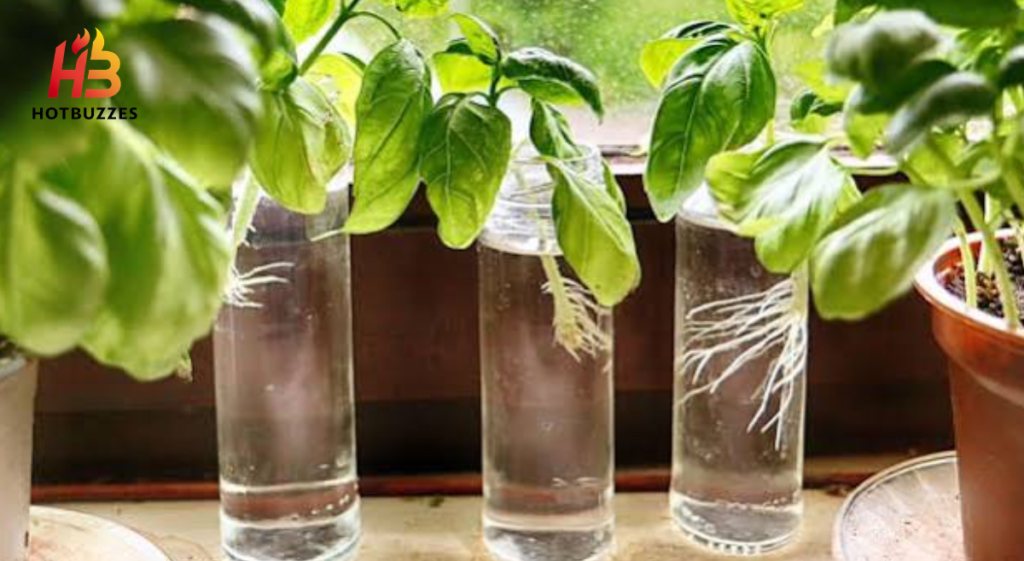
Water propagation offers an alternative succession method that costs nothing beyond the effort. Cut a four- to six-inch stem just below a node, remove the lower leaves, and place the stem in a glass of clean water with the nodes submerged but leaves above the waterline. Roots develop within seven to fourteen days, at which point the cutting can be potted into fresh soil. This produces genetic copies of the parent plant, useful when a specific variety has performed particularly well, and you want to maintain it exactly rather than starting from seed.
Overwintering Basil: What Actually Works
The question of whether basil can survive winter indoors is one that gets conflicting answers in most guides, and the conflict is explained by USDA hardiness zone differences that most UK and northern European guides do not address.
Blooming Expert makes the zone-specific situation clear: a south-facing window works for indoor basil only in zones 8 through 10. In zones 3 through 7, winter sun angles are insufficient for window-only basil. A full-spectrum LED grow light running fourteen to sixteen hours per day is the reliable winter solution in cooler climates.
The Old Farmer’s Almanac confirms: for the best flavour and good growth, plants will need six to eight hours of sunshine a day. If grow lights are used, keep them on for twelve hours each day. Invest in a timer; running a grow light on a manual basis is unreliable, and the consistent photoperiod matters for plant health.

The practical overwintering approach that works regardless of climate: move the most productive plants indoors before the first cold night of autumn, place under a grow light on a fourteen-hour timer, reduce watering frequency to match the plant’s slowed winter metabolism, stop fertilising, and maintain temperatures above 15 degrees Celsius at all times. Healthy Houseplants confirms the nighttime minimum of 50 degrees Fahrenheit (10 degrees Celsius) as the threshold below which basil visibly declines.
The Variety Choice That Changes Indoor Performance
Not all basil varieties perform equally well indoors, and the standard Genovese variety sold in most supermarkets is not the optimal choice for a small indoor pot with limited light. OurGardenWorks specifies the pot size minimum for Genovese basil at six inches — a size that suits it well but takes up significant windowsill space. Compact dwarf varieties require only a four-inch pot and perform better in the lower light levels and smaller spaces typical of indoor growing.
The varieties with the best indoor track record include Spicy Globe, a compact globe-forming variety with small leaves. It bolts more slowly than large-leaved types and suits limited space. Aristotle is a similar compact globe variety bred specifically for container performance. Pistou is a French compact variety with intensely flavoured small leaves. It holds its shape well under indoor conditions.
For growers specifically interested in Genovese-style leaves, Dolce Fresca is a variety bred for compact container growing that maintains the large leaf profile of Genovese while being significantly more heat-tolerant and slower to bolt than the standard variety. It is increasingly available from seed suppliers as the demand for container-specific basil varieties has grown.
FAQs
Q1: Why does my basil wilt even though I just watered it?
This is the most counterintuitive basil problem, and it is caused by overwatering rather than drought. When roots sit in waterlogged soil, they cannot absorb water due to oxygen deprivation — the plant wilts from internal drought despite water being present everywhere around the root zone. Check that the pot has drainage holes, let the soil dry significantly before the next watering, and if the soil smells sour or the stem base feels soft, root rot has begun and repotting in fresh dry soil is needed.
Q2: How long can a single indoor basil plant last?
With consistent spike removal and regular pinching, a single well-maintained indoor basil plant can remain productive for three to five months. Eventually, bolting becomes difficult to prevent as the plant ages. At this point, starting a new plant is more productive than extending an aging one. A succession system, where new plants are started every four to six weeks, eliminates the gap between a declining plant and its replacement.
Q3: Can I use a supermarket basil pot as a long-term plant?
With modification. Supermarket basil pots contain many plants crowded together with depleted soil designed for short-term retail display. Divide the root ball into three or four clumps and repot each into its own six-inch pot with fresh potting mix. This gives each clump room to develop a healthy root system. The resulting individual plants, grown with proper light and watering, produce continuously for months.
Q4: What is the difference between sweet basil and Thai basil for indoor growing?
Sweet basil and Genovese basil are the most common types for Italian cooking and general use. Thai basil has a distinct anise flavour, purple stems, and is used in Southeast Asian dishes. Thai basil is notably more heat-tolerant and slower to bolt than sweet basil, making it potentially more manageable as a long-term indoor plant. It handles the warm kitchen environment well and is worth growing alongside standard basil for culinary variety.
Q5: My basil leaves have dark patches that appeared overnight. What happened?
Dark water-soaked patches that appear suddenly, particularly in winter, are almost always cold damage. The plant has been exposed to temperatures below 10 degrees Celsius, usually from contact with cold glass or a cold draft overnight. The affected leaves do not recover. Remove them, move the plant away from direct contact with the window glass, and check for any drafts around the window frame that could be causing overnight temperature drops.
Q6: Should I use a terracotta or plastic pot for indoor basil?
Plastic pots retain moisture longer, which suits basil’s preference for consistent moisture but increases root rot risk if watering is slightly too frequent. Terracotta pots dry faster through their porous walls, which protects against overwatering but requires more frequent checking in warm conditions. The most important factor in either case is a drainage hole; the pot material matters less than the drainage does.
Conclusion
Basil survives indoors without dying when two things are consistently right: the light is adequate, and the watering is responsive rather than scheduled. Every other care decision (soil mix, pot size, humidity, fertiliser rate, variety selection) is meaningful but secondary to those two.
The grow light solves the light problem completely for anyone without a strong south-facing window or living north of zone 8. Positioned four to six inches above the canopy and running fourteen to sixteen hours daily on a timer, it provides better growing conditions than a windowsill in winter regardless of direction. The finger test solves the watering problem: checking the top inch of soil before every watering rather than watering on any fixed schedule prevents both overwatering and underwatering with a thirty-second daily check.
Add consistent node pinching to keep the plant bushy, remove every flower spike before it opens, and start a new plant on a rolling schedule so a replacement is always a few weeks away when the current plant eventually declines. That system produces fresh basil daily without gaps, without the repeated cycle of purchase and decline that characterises most people’s indoor basil experience.

Asim Usman is a plant enthusiast and content writer who specializes in creating informative, reader-friendly articles on plant care and gardening. He combines thorough research with practical insights to provide accurate, easy-to-follow guidance that helps readers grow healthy plants with confidence. His goal is to make plant care simple, enjoyable, and accessible for everyone.